
Reverse Osmosis: What Is It, How Does It Work, and Is It Worth Choosing?
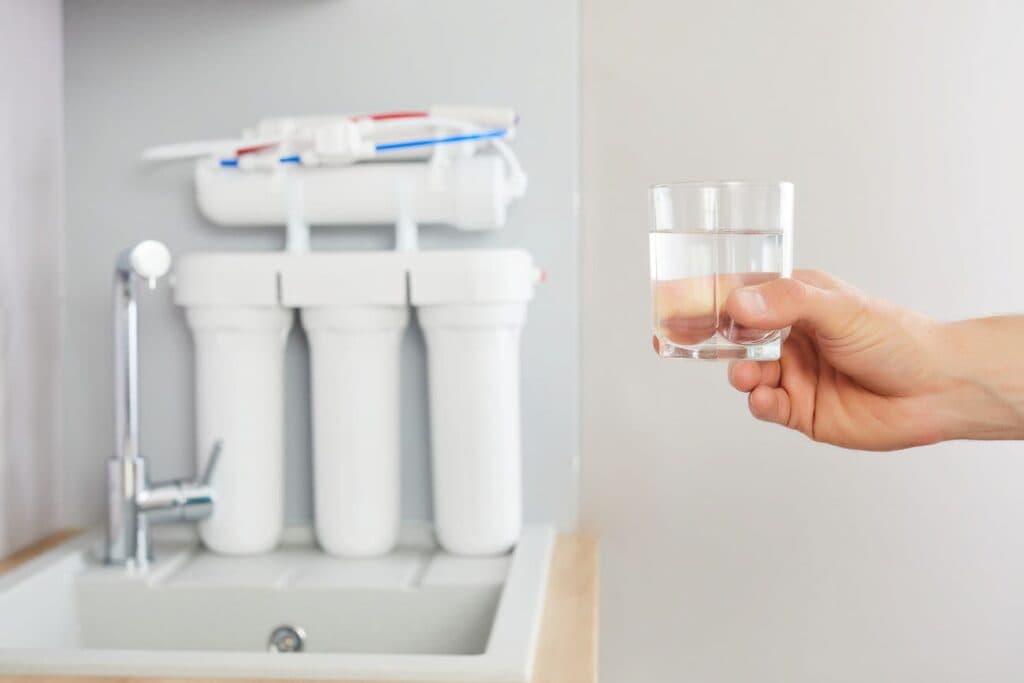
Reverse osmosis is one of the most effective water purification technologies, allowing you to achieve molecular-level purity at home that ordinary filters rarely provide. Water supply quality in Lithuania varies by region, and well or borehole water often contains iron, nitrates, or heavy metals, so the need for a reliable filtration system keeps growing.
Does every type of water actually require an RO system? And how much does it really cost compared to bottled water? Below you'll find answers about how RO works, its filtration stages, the range of contaminants it removes, real-world prices, and maintenance frequency.
What Is Reverse Osmosis and How Does It Differ From Natural Osmosis?
Reverse osmosis (RO) is a water filtration technology in which water is passed through a semi-permeable membrane that retains up to 99% of contaminants, heavy metals, bacteria, and chemical compounds.
Natural osmosis works the opposite way: water naturally moves from a solution of lower concentration to one of higher concentration through a membrane, seeking to balance the two sides. Reverse osmosis reverses this process by applying additional pressure to the water, forcing it to move in the opposite direction. This allows pure water molecules to pass through the membrane while contaminants remain on the other side.
The simplest analogy: an RO membrane works like an extremely fine sieve, letting only water molecules through while retaining everything larger than them.
How does this differ from ordinary filters? Sediment filters only retain larger particles, such as sand or rust. Activated carbon filters remove chlorine and organic impurities. Neither works at the molecular level, so neither can remove dissolved heavy metals, nitrates, or pharmaceutical residues. That's precisely why RO systems are considered one of the most effective residential water treatment technologies.
How Does a Reverse Osmosis Filtration System Work?
A residential RO system purifies water by passing it through several sequential filtration stages. Each stage removes a different type of impurity, and the final water reaches molecular-level purity.
Filtration Stages: Sediment, Carbon, RO Membrane, and Mineralizer
A residential RO system purifies water in five sequential stages:
- Sediment filter retains sand, rust, and larger particles, protecting the subsequent stages from clogging.
- Activated carbon filter removes chlorine, organic matter, and compounds causing unpleasant odor and taste.
- RO membrane lets through only water molecules, retaining heavy metals, nitrates, bacteria, and other contaminants.
- Post-osmosis carbon filter gives the water its final taste polish.
- Mineralizer restores calcium, magnesium, and other beneficial minerals.
This last stage isn't mandatory in every system, but it's recommended for drinking water, since without it RO water is left without essential minerals.
Direct-Flow and Indirect-Flow Systems: What's the Difference?
Indirect-flow systems produce water more slowly (50–100 GPD) and store it in a pressure tank. Thanks to their simpler design, they cost less and are a great fit for a household of 1–2 people.
Direct-flow systems use a more powerful membrane (400–800 GPD) and a pressure pump, so water is filtered instantly, without a storage tank. These systems are more compact and capable of serving a larger household or office.
When choosing, it's worth considering your daily water consumption. For a larger family or office, a direct-flow system ensures an uninterrupted supply, while an indirect-flow system will comfortably cover a small apartment's needs.
What Does Reverse Osmosis Remove, and Why Does It Matter for Your Health?
The RO membrane retains nitrates, heavy metals (lead, mercury, arsenic), bacteria, viruses, chlorine, pesticides, pharmaceutical residues, and microplastics. It's a molecular-level barrier that ordinary sediment or carbon filters simply cannot match.
This technology is especially relevant in Lithuania. Borehole and well water frequently contains nitrates, iron, and manganese, while centrally supplied water can retain traces of chlorine and impurities from old piping, particularly in older apartment buildings.
Is such water safe to drink? Yes, provided the system includes a remineralization filter. Without it, RO water also loses beneficial minerals such as calcium and magnesium, so a mineral-restoring stage is recommended for long-term consumption.
Remineralization: Why Does RO Water Need Its Minerals Restored?
The RO membrane removes not only contaminants but also minerals beneficial to the body: calcium, magnesium, potassium. As a result, the filtered water becomes overly pure, with a flat, unnatural taste.
A remineralization filter restores water's optimal mineral composition. The water becomes not only tastier but also more physiologically suited to daily consumption. Among water quality specialists, the consensus is clear: an RO system intended for drinking water must include a remineralization stage.
Many bottled water producers use the identical RO process followed by remineralization, yet the final price for consumers ends up several times higher than filtering water at home.
Reverse Osmosis System Cost, Maintenance, and Long-Term Expenses
In 2026, a basic indirect-flow system in Lithuania costs €150–300, while a direct-flow system with a pressure pump runs €400–800. The initial investment is only part of the total cost.
Sediment and carbon filters need replacing every 6–12 months, and the RO membrane every 2–3 years. Annual running costs typically add up to around €30–60. In the long run, this is one of the most cost-effective ways to ensure clean drinking water. You can find more about these systems among our drinking water solutions.
Reverse Osmosis vs. Bottled Water: An Economic and Environmental Comparison
A family of four spends several hundred euros a year on bottled water, while annual RO filter maintenance costs around €30–60. An investment in a water treatment system typically pays for itself within the first year.
A large share of bottled water on the market is the very same RO-filtered water with minerals restored, just sold at several times the price. On top of that, every RO system eliminates hundreds of plastic bottles a year, contributing to more sustainable consumption.
How to Choose a Reverse Osmosis System Based on Your Needs
Choosing the right system depends on your water source and consumption volume. In an apartment with a centralized water supply, a standard under-sink RO system is enough. In a private house with a borehole, additional iron removal or softening ahead of the RO unit is often needed, since iron and hardness wear out the membrane faster.
For an office or a larger household, a direct-flow system with higher GPD capacity is the right fit.
Before buying, it's recommended to have a chemical water analysis done, especially for borehole or well water. This allows you to match home water filters to your specific problems instead of guessing.
What to Look For When Choosing: GPD, Water Waste Ratio, Additional Filters
GPD (gallons per day) shows how much clean water the system produces per day. A household of 1–2 people needs only 50–100 GPD, while a larger family or office needs 400–800 GPD, since lower capacity can't keep up with peak consumption.
Another metric, the so-called "waste ratio," shows the ratio of clean water to wastewater. Modern systems achieve 1:1, while older ones may run at 1:3. The water isn't wasted in the literal sense – it's flushed away along with the contaminants. Even a 1:2 ratio remains more cost-effective than bottled water.
Among additional filters, the most valuable are a UV filter, which provides extra protection against microorganisms, and a mineralizer for drinking water. You can find more details on choosing components in our water filter selection guide.
Frequently Asked Questions About Reverse Osmosis
Is Reverse Osmosis Water Suitable for Preparing Baby Food?
Yes, RO water combined with a mineralization filter is one of the safest options for infant formula. The system eliminates the risk of nitrates, heavy metals, and bacteria, while the remineralization stage restores the minerals the water needs.
How Much Water Does a Reverse Osmosis System Waste?
Modern systems achieve a 1:1 ratio of clean water to wastewater, while older ones operate at 1:2 or 1:3. The water isn't wasted for nothing – it's discharged into the drain along with the contaminants. Even at a 1:2 ratio, this remains more economical than bottled water.
How Often Do Reverse Osmosis Filters Need to Be Replaced?
Replace sediment and carbon filters every 6–12 months, and the RO membrane every 2–3 years. The exact interval depends on water quality and how intensively the system is used. Regular maintenance extends the service life of the entire system.
Is Reverse Osmosis Suitable for Well or Borehole Water?
Yes, though iron and manganese present in well or borehole water foul the membrane faster. Additional iron removal or water softening ahead of the RO unit is often needed, so a chemical water analysis is recommended first.
Is a Reverse Osmosis System Difficult to Install?
Most residential RO systems are installed under the sink, and the process takes about 1–2 hours. Even so, professional installation is recommended to ensure the system runs optimally and to avoid leaks. Aquafilter provides installation services throughout Lithuania.
The Aquafilter team, with nearly three decades of experience in water treatment, helps you select the most suitable reverse osmosis system based on your water quality and needs. From water analysis to professional installation and regular maintenance, every stage is handled by qualified water treatment specialists trusted by more than 40,000 customers across Lithuania.
If you'd like clean, safe drinking water straight from the tap, check out our drinking water systems or get in touch with the Aquafilter team for a personal consultation.