
What Are the Types of Water Iron Removal Filters? A Guide to Choosing the Right One
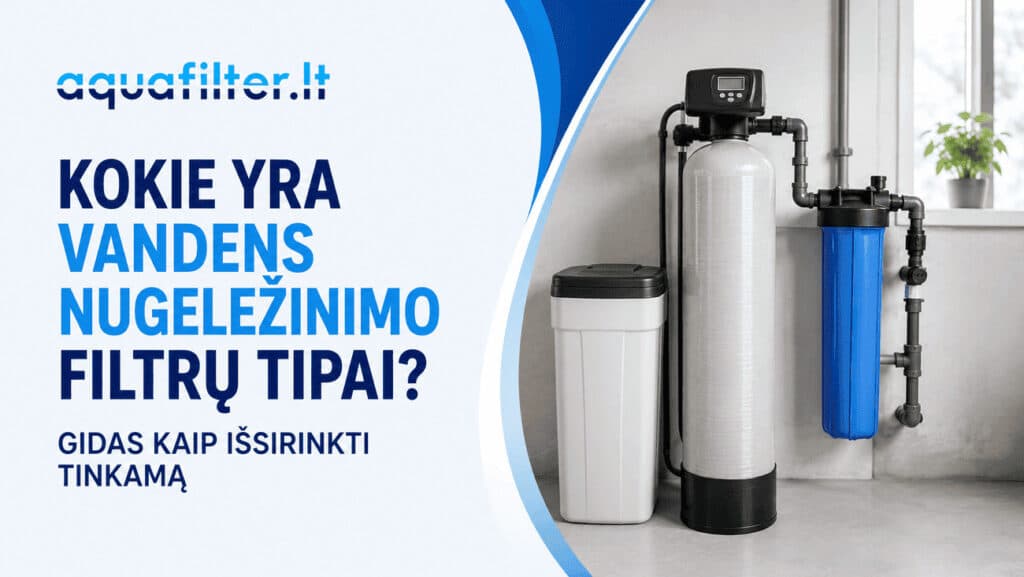
Many people choose a water iron removal filter by comparing manufacturers, prices, or other people's recommendations. However, iron removal systems work somewhat differently. The same filter can effectively solve the problem in one home and be completely ineffective in another. It all depends on the form of iron in the water, its concentration, the manganese level, and the water's pH.
In Lithuania, elevated iron levels in borehole water are a very common occurrence. Rust stains on plumbing fixtures, a yellowish tint to the water, a metallic taste, or an unpleasant hydrogen sulfide smell often indicate that the water needs additional treatment. That's why, before choosing a filter, it's important not to guess but to rely on water test results, which allow you to accurately assess the scale of the problem and select the most suitable water treatment technology.
In this article, we'll cover the main types of water iron removal filters, how they work, and the differences between them. We'll also explain when it's worth choosing single-tank or twin-tank systems, in which cases additional aeration is needed, and which water parameters must be assessed before investing in water treatment equipment.
When Is a Water Iron Removal Filter Needed: Signs of Water Quality Issues
An iron removal filter is needed when the iron concentration in the water exceeds the 0.2 mg/l limit set by the Lithuanian hygiene standard HN 24:2017, or when the manganese concentration exceeds 0.05 mg/l. Once these threshold values are exceeded, changes in the water's color, smell, and taste often appear, and over time plumbing fixtures and laundry suffer as well.
Elevated levels of iron and manganese in water can be recognized by several characteristic signs:
- Rust-colored stains on plumbing fixtures, bathroom surfaces, and laundry.
- A yellowish or brownish tint to the water.
- A metallic taste in the drinking water.
- Black or brown stains caused by manganese.
- A rotten-egg smell caused by hydrogen sulfide (H₂S).
Interestingly, water fresh from the tap can appear perfectly clear, yet turn brown after standing for a while. This happens because water from deeper boreholes tends to contain less dissolved oxygen, so the iron stays dissolved and invisible to the naked eye. Once it comes into contact with air, it oxidizes and settles out as rust.
Water from Lithuanian boreholes often has elevated iron and manganese concentrations along with greater hardness, which is why iron-rich water is one of the most common water quality problems. Testing for manganese in borehole water has been mandatory since November 2019, as its impact on water quality had long been underestimated.
It's worth knowing that the 0.2 mg/l iron concentration limit applied in Lithuania is stricter than the 0.3 mg/l aesthetic guideline value set by the US Environmental Protection Agency (EPA). This reflects higher water quality requirements and greater attention to consumer comfort and the aesthetic qualities of water.
Water Analysis Before Choosing a Filter: What Needs to Be Tested?
A water test is the essential first step, because the type of filter needed is determined not by the manufacturer or brand, but by the form of iron present (dissolved or oxidized), its concentration, and the water's pH. Without this data, it's impossible to select a filter media that will effectively remove the contaminants.
A complete test should cover the following parameters:
- Iron and manganese concentration and their forms.
- Ammonium concentration, since ammonium is often found in borehole water.
- Water hardness, determined by calcium and magnesium compounds.
- Hydrogen sulfide (H₂S) concentration, as it causes the rotten-egg smell.
- Water pH, which affects oxidation processes and filtration efficiency.
pH is a particularly important parameter, since many oxidizing filter media only work effectively within a certain pH range. For example, the "Birm" media used for iron removal requires a pH of at least 6.8, while removing manganese requires a pH of at least 7.5. At lower pH levels, the oxidation process isn't efficient enough, so some of the iron remains dissolved and doesn't get removed during filtration.
Without a water test, an unsuitable or ineffective unit may be chosen, since the same filter media, if it doesn't meet the required pH or dissolved oxygen conditions, may fail to remove iron effectively. In that case, the investment in a filtration system may not pay off.
Working with certified testing laboratories ensures that the chosen solution matches the water's actual composition rather than assumed values.
Types of Water Iron Removal Filters and Their Features
The type of filter is selected based on the concentration and forms of iron and manganese, so different water compositions call for different solutions. With a low iron content, a simpler unit may be enough, while higher concentrations or a strong smell usually call for more intensive oxidation.
The table below helps you quickly assess which type of filter best matches your water test results.
| Type | Iron (mg/l) | Manganese | H₂S smell | Space required | Operation |
| Single tank | up to ~3 | inconsistent | limited | low | low |
| Twin tank with injector | 3–10 | moderate | partial | moderate | moderate |
| Twin tank with compressor | over 5 | good | good | high | higher (electricity costs) |
| Combined | up to 5 | limited | limited | low | moderate |
The choice depends on the predominant form of iron and the water's pH, since these are the parameters that determine the media's effectiveness.
Single-Tank Iron Removal Filter
This is the simplest solution for removing small to moderate amounts of iron when the raw water contains enough dissolved oxygen. For example, the "Birm" media used for iron removal requires a dissolved oxygen concentration of at least 4 mg/l and a pH of at least 6.8, so it's only suitable for water of a certain composition.
The operating principle is simple: the media in a single unit oxidizes dissolved iron and traps the resulting particles. "Birm" media doesn't require regeneration, since it uses the oxygen already present in the water, making it cheaper to run than systems that need chemical regeneration.
However, this type of filter also has certain limitations. Its effectiveness at removing manganese can be inconsistent, and at low pH or high iron levels it isn't suitable without additional aeration. The most suitable iron removal media can only be chosen after a water test.
Twin-Tank Filter with an Air Injector
This system is suitable when the water has a high iron content and relatively few mechanical impurities. The air injector automatically draws air into the water stream, so dissolved iron oxidizes and turns into particles that can be filtered out. This process takes place without the use of any additional chemicals.
The twin-tank design provides greater efficiency than a single-tank system. In the first tank, the water is aerated, causing the iron to oxidize, while the second tank traps the resulting particles. This achieves a more stable and effective water treatment result.
When operating the system, periodic backwashing is necessary to remove accumulated sediment from the filter tank. Since a certain amount of water is used during regeneration, it's worth assessing water flow rate and drainage options when planning the system's installation.
Twin-Tank Filter with an Air Compressor
This is the most effective solution when the water contains high levels of iron and manganese, since the compressor ensures a stable, uninterrupted air supply. As a result, oxidation is more intensive and even than with an air injector, which only draws in air with the help of the water flow.
This system is especially suitable when there is a high combined concentration of iron and manganese, or a strong hydrogen sulfide smell. Aeration oxidizes not only these metals but also helps eliminate the rotten-egg smell, so a single unit can address several water quality problems at once.
A stable air flow ensures a more consistent treatment result even as contaminant concentrations fluctuate. However, this system takes up more space in the utility room and requires electricity to run the compressor. This trade-off is often worthwhile in cases where other iron removal methods fail to deliver the necessary effectiveness.
Combined-Action Filter
A combined-action filter removes iron and reduces water hardness in a single unit, using a mixed media with ion-exchange resin. This is a convenient solution when both elevated iron levels and water hardness need to be addressed at the same time.
However, ion-exchange resin has clear operating limits. It only removes iron when the water's pH exceeds 6.7, hardness is between 50–350 mg/l, and the dissolved iron concentration is below 5 mg/l. In addition, the raw water must not come into contact with air before reaching the filter, since oxidized iron clogs the resin and reduces the system's effectiveness.
Thanks to its compact size, this solution is especially convenient for small households, where it's important to save space in the utility room while addressing several water quality issues at once.
How to Choose the Right Iron Removal Filter: Selection Criteria
The choice of the most suitable iron removal filter is determined by the iron concentration, the water source, and the amount of water consumed, so the decision should always start with water test results. Without this data, it's impossible to assess whether the chosen media will match the water's actual composition.
Based on iron concentration, you can follow these guidelines:
- Low iron concentration (up to a few mg/l, with enough dissolved oxygen present) – a single-tank filter.
- Moderate to high iron concentration – a twin-tank system with aeration (air injector or compressor).
- When the iron concentration exceeds 10 mg/l and elevated manganese is also found, chemical oxidation followed by filtration is usually applied, since aeration alone is no longer enough.
The water source also influences the choice of media. Water from deep boreholes more often contains dissolved iron and has less dissolved oxygen than water from dug wells, so active aeration is often needed before filtration. Dug-well water, on the other hand, being in constant contact with air, often already contains oxidized iron.
When choosing a filter, it's also worth considering operating costs: the amount of water used for backwashing, the compressor's electricity needs, how often the media needs replacing, and the space required in the utility room. These factors determine the overall long-term cost of running the system.
The most common mistakes happen when a filter is chosen without a water test or without assessing the water's pH, causing the oxidizing media to work ineffectively. In households with high water consumption, an undersized system can quickly cause a drop in water pressure.
Additional Types of Water Filters: Softening, Carbon, Reverse Osmosis, and UV
Iron removal is often combined with other water filters, since a single unit can't solve every water quality problem. Even after the iron is removed, the water may still have excessive hardness, unpleasant odors, or microorganisms, which is why a water treatment system is often assembled from several stages, based on the water test results.
A water softener removes calcium and magnesium ions through ion exchange, using a cation resin media. It's installed after the iron removal filter, since oxidized iron can clog the resin. Specialized water softeners are used to soften hard water, helping protect plumbing fixtures from limescale buildup.
An activated carbon filter removes chlorine, residual odors, and unwanted taste. It's most often used after chemical oxidation, when residual chlorine remains in the water, making it especially suitable for systems where iron is removed using sodium hypochlorite.
A reverse osmosis (RO) system removes dissolved salts and fine impurities using a semi-permeable membrane. It's most commonly installed in the kitchen to prepare drinking water, since it delivers an exceptionally high level of water purification.
A UV sterilizer destroys bacteria and other microorganisms using ultraviolet light, without the use of any chemicals. This is especially relevant for dug-well water and water that has undergone aeration, since bacteria can multiply within the aeration system, making disinfection an important extra safeguard.
For odor problems, especially the unpleasant smell caused by hydrogen sulfide, aeration and an activated carbon filter are often combined to ensure a stable, long-lasting result.
Water Iron Removal Filters: Frequently Asked Questions
What Are the Main Types of Water Iron Removal Filters?
There are four main types of water iron removal filters: a single-tank filter, a twin-tank filter with an air injector, a twin-tank filter with an air compressor, and a combined-action filter.
A single-tank filter is suitable for low to moderate iron concentrations when the water contains enough dissolved oxygen. A twin-tank system with an air injector is designed for higher iron concentrations, while a twin-tank system with an air compressor works most effectively when both iron and manganese concentrations are high. A combined-action filter removes iron and reduces water hardness at the same time, making it a convenient solution for smaller households.
Which Iron Removal Filter Is Best for High Iron Levels?
For high iron levels, the most suitable option is a twin-tank system with an air compressor, since a stable, uninterrupted air flow ensures intensive, even iron oxidation.
When the combined iron and manganese concentration exceeds 10 mg/l, chemical oxidation followed by filtration is usually required, using chlorine or potassium permanganate. The final decision depends on the water test results and the volume of water consumed, so even with the same contaminant concentration, different households may need systems of different capacity.
How Can You Tell if Your Water Has Too Much Iron?
The main signs are rust-colored stains on plumbing fixtures and laundry, a metallic taste in the water, a yellowish or brownish tint, and a rotten-egg smell caused by hydrogen sulfide.
According to HN 24:2017, the iron concentration limit is 0.2 mg/l, but the exact amount can only be determined through a laboratory water test. You can find more information on how to solve this problem in the "Iron-Rich Water" section.
Do You Need a Water Test Before Buying a Filter?
Yes, a water test is essential, since its results show the iron, manganese, ammonium, hardness, and pH levels that determine which filter is appropriate.
Without this data, an ineffective unit may be chosen, since the performance of most oxidizing media depends directly on the water's pH and dissolved oxygen level. For example, ion-exchange resin only removes iron when the pH exceeds 6.7, so without precise figures, choosing a filter becomes guesswork.
The right choice of iron removal filter is determined not by the brand, but by precise water parameters: the form of iron, its concentration, the manganese level, and the water's pH. That's why every decision should start with a chemical water test, which shows whether an oxidizing media will be enough, or whether aeration with an air compressor will be needed. Nearly three decades of experience, together with collaboration with Lithuanian scientists and certified laboratories, allows us to select equipment that effectively removes contaminants and helps ensure water quality that meets the requirements of HN 24:2017.
If your borehole water leaves rust stains or has a metallic taste, we'll help you choose the most suitable solution based on your water's parameters. Contact us, and our engineers will offer an individual water treatment solution and ensure ongoing service and a steady supply of consumables.