
What Are the Most Popular Types of Water Filters? A Guide to Choosing the Right One
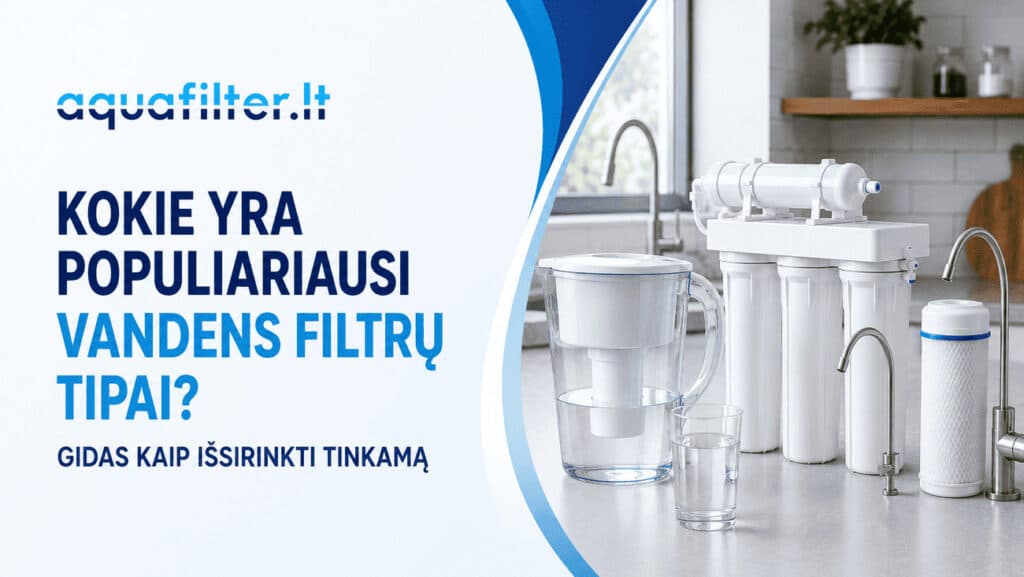
When looking for a water filter, people often expect a simple answer: which option is best? But in water treatment, there is no universal solution. A filter that effectively removes one type of contaminant may be completely unsuitable for solving other water quality problems. That's why, before choosing equipment, it's important to understand not only the differences between filters, but also what substances are actually present in your water.
Municipal, well, and borehole water each face different challenges. In some cases, chlorine and an unpleasant taste need to be removed; in others, it's iron, manganese, limescale, or even microbiological contamination. For this reason, modern water treatment systems are often made up of several filtration stages that together ensure clean, safe, and high-quality water for everyday use.
In this article, we'll review the most popular types of water filters, how they work, and their key differences. We'll also explain when it's worth choosing sediment, activated carbon, softening, iron removal, reverse osmosis, or UV filters, and why a water test is the most important step before making a final decision.
What Are the Most Popular Types and Kinds of Water Filters?
The most popular types of water filters include sediment (mechanical), activated carbon, water softening, iron removal, reverse osmosis (RO), and ultraviolet (UV) filters. Each is designed to remove different substances, so in practice these filtration methods are often combined in a single system.
For example, a sediment filter traps solid particles, an activated carbon filter reduces chlorine levels and unpleasant odors, while a reverse osmosis (RO) system removes dissolved contaminants. A single unit rarely solves all water quality problems.
| Filter Type | What It Removes | NSF/ANSI Standard | Typical Use |
| Sediment (mechanical) | Solid particles, oxidized iron | – | Pre-filtration |
| Activated carbon | Chlorine, odors, taste | 42, 53 | Municipal water |
| Softening | Calcium, magnesium (water hardness) | 44 | Hard/scaling water |
| Iron removal | Iron, manganese | – | Borehole water |
| Reverse osmosis | A wide range of contaminants | 58 | Drinking water |
| Ultraviolet (UV) | Bacteria, viruses, cysts | 55 | Microbiological risk |
The basic principle is simple: no single unit removes all contaminants. That's why, in real-world conditions, several water treatment processes usually need to be combined, selected according to the specific composition of the water.
Sediment and Cartridge Filters
A sediment (mechanical) filter removes solid particles and oxidized iron, which is why it's usually installed as the first filter in a water treatment system. This position allows sand, rust, and other suspended particles to be captured before the more sensitive water treatment stages.
This principle is especially important in reverse osmosis systems, where the sediment filter protects the semi-permeable membrane from clogging. Since larger particles are captured in advance, the membrane gets dirty less quickly, extending its service life.
In practice, the most popular solution of this type is cartridge filters. They are valued for their affordable price and easy maintenance, since the contaminated filter cartridge can be replaced at home, without needing any special tools.
It's worth learning more about cartridge water filters when choosing the first stage of your water treatment.
Activated Carbon Filters
Granular activated carbon (GAC) removes most contaminants that cause unpleasant odor, color, and foaming, and is especially effective at reducing chlorine levels. This action is based on the principle of adsorption, where contaminants adhere to the large surface area of the activated carbon, giving the water a better taste and smell.
Activated carbon filters are usually certified to the NSF/ANSI 42 and NSF/ANSI 53 standards. Both standards are based on the adsorption principle, but they define different performance requirements and different groups of contaminants to be reduced. These standards help assess which contaminants a filter can actually reduce.
The difference between them is essential when choosing a filter. NSF/ANSI 42 is an aesthetic standard covering taste and chlorine reduction, while NSF/ANSI 53 applies to health-hazardous, EPA-regulated contaminants, such as heavy metals. A practical solution for households is activated carbon cartridges.
Water Softening and Iron Removal Filters
A water softener works on the principle of ion exchange (NSF/ANSI 44) and removes the calcium and magnesium ions responsible for water hardness, replacing them with sodium or potassium ions. This reduces the formation of limescale deposits in pipes, appliances, and plumbing fixtures.
The core component of the system is a cation exchange resin, which gradually becomes saturated with hardness-causing ions over time. It is therefore periodically regenerated with a sodium or potassium chloride solution, which means the salt supply needs to be topped up regularly.
The right solution depends on the water's hardness. According to the USGS classification (CaCO₃), water is categorized as follows:
- 0–60 mg/l – soft.
- 61–120 mg/l – moderately hard.
- 121–180 mg/l – hard.
- More than 180 mg/l – very hard.
Iron removal filters address a different problem, removing dissolved iron and manganese compounds that cause brown staining and a metallic taste. Borehole water often requires both solutions, so in practice water softeners are combined with iron removal filters.
Ultraviolet (UV) Filters
Ultraviolet treatment systems (NSF/ANSI 55, Class A) inactivate bacteria, viruses, and cysts without using any chemicals. UV radiation damages microorganisms' DNA, so they lose the ability to reproduce and become harmless.
This solution is especially relevant for well and borehole water, where the risk of microbiological contamination is higher. Unlike chlorination, UV treatment does not change the taste or smell of water, making it ideal for preparing drinking water.
However, UV filters have no effect on dissolved contaminants, iron, or sediment. Turbid particles can block the ultraviolet rays and reduce disinfection effectiveness. For this reason, mechanical filtration is essential before a UV system, ensuring clear water and allowing the radiation to reach all microorganisms.
The Most Effective and Most Commonly Used Water Filter
At home, cartridge and activated carbon filters are usually chosen for their affordable price and easy maintenance, while reverse osmosis systems are becoming increasingly popular for drinking water.
But it's impossible to name a single most effective filter type, since no unit removes all contaminants. The most suitable solution depends on which substances predominate in the specific water.
The practical choice is determined by the main problem:
- Chlorine and unpleasant odor can be reduced with an activated carbon filter (NSF/ANSI 42), which works on the adsorption principle.
- The limescale problem is solved with a water softener (NSF/ANSI 44), which reduces the level of calcium and magnesium ions.
- To neutralize bacteria and viruses, a UV treatment system (NSF/ANSI 55) is suitable.
- Wide-spectrum contaminant removal is most effectively achieved with a reverse osmosis system (NSF/ANSI 58).
Because of this, a filter's effectiveness can only be assessed based on specific water parameters. For example, when nitrate concentration is high, even a reverse osmosis system cannot always guarantee the required result, so the final effectiveness depends on the initial composition of the water.
This means the first step in choosing a filter should always be a water analysis, which shows which process or combination of processes to choose.
Reverse Osmosis (RO) Filters: How They Work and What They're For
A reverse osmosis system (NSF/ANSI 58) purifies water by forcing it through a semi-permeable membrane that lets water molecules through but retains dissolved contaminants. Because of this, RO is considered one of the most effective broad-spectrum household water treatment technologies.
A household reverse osmosis (RO) system removes most health-hazardous compounds, making it suitable for preparing drinking water when it contains:
- arsenic, iron, manganese, fluoride, and nitrates;
- lead, cadmium, chromium, and mercury;
- sulfates, radium, and uranium;
- protozoan cysts and cryptosporidium.
However, the membrane does not retain dissolved gases such as hydrogen sulfide, which causes a rotten-egg smell, nor certain volatile organic compounds (VOCs). For this reason, a reverse osmosis system is often combined with an activated carbon filter, which adsorbs these contaminants.
Water consumption is also important to consider. A typical household system operates at 20–30 % water-use efficiency, meaning some of the water is discharged as concentrate. Systems certified with the EPA's "WaterSense" label are more efficient – they release no more than 2.3 liters of wastewater per liter of purified water.
The final result is determined by the initial contaminant concentration. For example, with 85 % nitrate rejection efficiency, a starting concentration of 80 mg/l is reduced to about 12 mg/l of nitrates, which still exceeds the EPA's 10 mg/l limit.
How to Choose the Right Water Filter Based on Water Source and Needs
Choosing the most suitable water filter depends on three criteria: the water source, the scale of use, and the installation location. For municipal water, removing chlorine and improving taste is usually enough, while borehole and well water, due to their variable composition, often require a more complex combination of water treatment processes.
The installation location depends on where and how much water needs to be treated. Point-of-use filters, installed under the sink, are designed only for drinking water, so they suit smaller water volumes and a specific purpose. Whole-house filters treat the entire water supply line, protecting plumbing and appliances from limescale and rust.
Borehole water problems have clear solutions. Excess iron and manganese are removed with iron removal filters or similar solutions, limescale is removed with water softeners, and hydrogen sulfide, which causes a rotten-egg smell, requires specific treatment.
Only a laboratory analysis can reveal the true composition of your water, which is why a water test is the most important step when choosing a filtration solution. Certified testing laboratories and water treatment specialists help select an effective combination of processes based on the water's chemical parameters.
Types of Water Filters: Frequently Asked Questions
Which water filter is most commonly used at home?
Cartridge and activated carbon filters are the most commonly chosen for home use, as they offer an affordable price and easy maintenance that can be done yourself by replacing the filter cartridge.
For drinking water, reverse osmosis systems are becoming increasingly popular due to their broad purification range. The final choice depends on the water source and its composition, so a water analysis helps determine the most suitable solution.
Which type of water filter cleans water most effectively?
A reverse osmosis (RO) system is considered one of the most effective, as it removes the widest range of contaminants, including heavy metals, nitrates, and microorganisms.
However, the most effective filter type depends on which contaminants need to be removed: an iron removal filter is suitable for iron, a water softener for limescale, and a UV filter for bacteria. That's why, before choosing a solution, it's essential to carry out a water test that reveals the true composition of the water.
Is a water test needed before choosing a filter?
Yes, a laboratory water test is the most important step, as it reveals the exact composition of the water and the specific substances that need to be removed.
The composition of borehole and well water changes over time, so it's worth repeating the water test periodically. Without testing, you risk buying an unsuitable filter that won't solve the problem and becomes an unnecessary expense.
Choosing the right water filter starts with clearly understanding the composition of your water, since each contaminant requires a different solution. Nearly three decades of experience working with certified laboratories and Lithuanian scientists allows us to select exactly the equipment your water needs – from softening and iron removal to reverse osmosis systems that remove a broad spectrum of contaminants.
If you want clean and safe water at home, in the office, or in industry, start with a chemical water test, and together we'll select the most effective solution for your situation. More than 40,000 customers throughout Lithuania already trust our individually tailored water treatment solutions and ongoing equipment maintenance.