
Lead in Water: Health Risks, Limits, and How to Protect Yourself
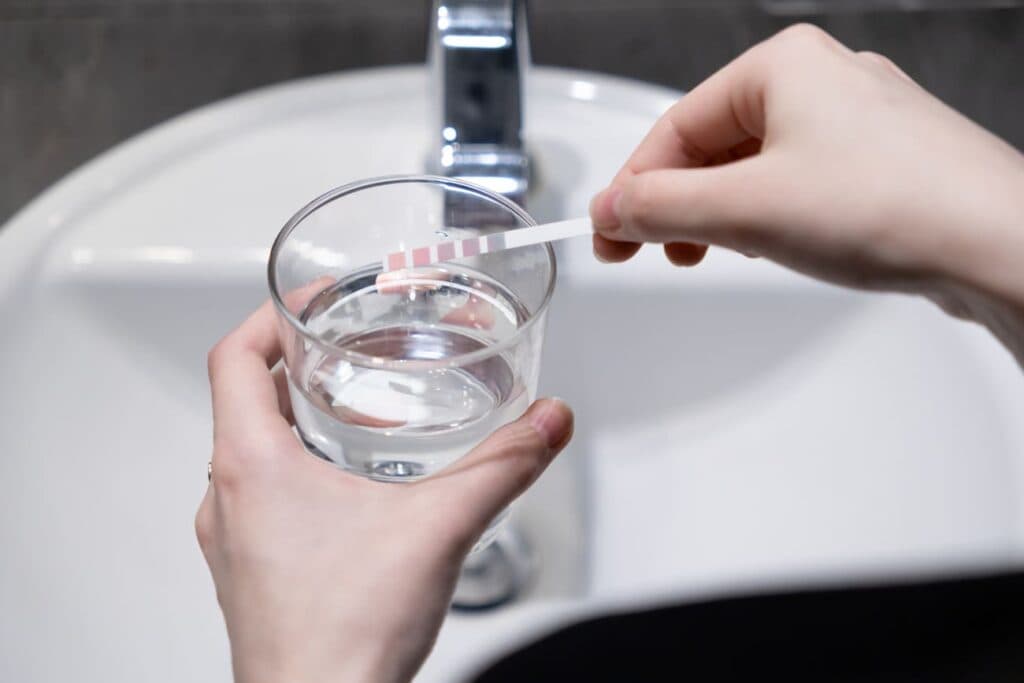
Lead in water is one of the most dangerous contaminants in drinking water, because even small concentrations build up in the body and damage the nervous system, kidneys, and children’s development. It usually doesn’t come from the water source itself, but from pipes, solder, and older plumbing fixtures inside the building.
In Lithuania, centrally supplied water generally meets the HN 24:2017 hygiene standard, but risk remains in older buildings, apartment blocks with original piping, and private wells where the internal plumbing has never been inspected. That’s exactly why it’s worth knowing how the metal gets into water, what limits apply, and which solutions actually work.
Below we cover the sources of lead contamination, its effects on different population groups, international and Lithuanian standards, water-testing options, and the most effective filtration methods that help reduce lead concentration to a safe level.
How Lead Gets Into Drinking Water: Sources and Causes
Lead almost never enters drinking water from the water source itself — a borehole or a surface water body. Contamination mainly occurs later, as water flows through pipes and fittings from which the metal leaches during corrosion.
Typical sources of lead in home plumbing include:
- Lead service pipes, used in water supply systems until the late 20th century.
- Lead solder, used to join old copper pipes.
- Brass faucets and fittings, which historically contained up to 8% lead.
- Old mixer faucets and valves, made before the 1986 restrictions.
The chemical composition of water directly determines how much lead leaches out. Soft, acidic water (low pH) aggressively corrodes metal surfaces, so lead concentration in such water tends to be higher than in hard, alkaline water.
A thin layer of oxides and carbonates usually forms on the inner surface of lead pipes, acting as a protective film that limits the metal’s migration into the water. When the water chemistry is stable, this layer stays intact.
However, a sudden shift in pH or disinfection method can break down this protective layer. This is exactly what happened in the 2014 Flint, Michigan (USA) crisis: after the water source was switched, corrosion inhibitors were not added, and lead from old pipes flooded into the drinking water of thousands of residents.
Lead Pipes, Solder, and Old Faucets
In home plumbing, lead hides in several typical spots: service pipes running from the street to the building, copper pipes joined with lead solder, brass fittings, and older mixer faucets whose housings may contain up to several percent lead impurities.
Although the US banned the use of lead solder and lead-containing components in drinking water systems in 1986, with the EU following later, buildings constructed before that period often still have their old connections in place. During renovations, part of the piping gets replaced, but hidden joints inside walls or floors are usually left untouched.
Hot water dissolves more lead than cold water, because higher temperatures speed up corrosion reactions and break down the protective oxide layer inside pipes. For this reason, it’s recommended to use only cold water for drinking, cooking, and preparing baby formula, and to heat water separately in a kettle when needed.
Lithuania’s Water Supply Infrastructure and Lead Risk
Centrally supplied water in Lithuania generally meets the requirements of the HN 24:2017 hygiene standard, so the risk usually doesn’t come from the water utility’s network, but from the building’s internal plumbing.
Apartment buildings and private homes built before the 1970s may have older connections made with lead solder, brass fittings, and outdated mixer faucets. In such buildings, lead gets into the water locally, even if the water arriving in the basement is clean.
A separate risk group is private boreholes and wells in rural areas. Their water quality isn’t regularly monitored by state institutions, so responsibility falls on the owner. If the house is old or the plumbing has only been partly replaced, it’s worth having a water test done for heavy metals so the risk can be assessed objectively.
Lead’s Effect on Health: Children, Pregnant Women, and Adults
There is no safe level of lead in the body. Both the World Health Organization (WHO) and the US Centers for Disease Control and Prevention (CDC) hold this position. Any detectable concentration in the blood is considered biologically significant, since this heavy metal serves no beneficial function in the human body.
Once in the bloodstream, lead gradually moves into the bones and teeth, where it can be stored for decades. Because of this slow buildup, chronic exposure often goes unnoticed, and symptoms appear only once the damage is already significant.
Lead accumulated in the bones can later re-enter the bloodstream when calcium is deficient, during pregnancy, or with osteoporosis. So past exposure can still pose a risk many years later.
Lead damages several organ systems at once:
- Nervous system – disrupts neurotransmitter activity, weakens memory and concentration.
- Kidneys – promotes chronic decline in kidney function and hypertension.
- Blood formation – suppresses hemoglobin synthesis, causing anemia.
- Reproductive system – reduces fertility in both men and women.
Why Are Children and Pregnant Women Especially Vulnerable?
A child’s body absorbs about 4–5 times more lead than an adult’s, because the digestive tract is more permeable at that age and the blood–brain barrier hasn’t finished forming. As a result, even a relatively low concentration in water can produce a much stronger toxic effect.
The developing brain is especially sensitive. Long-term exposure is linked to lower IQ, learning difficulties, a shorter attention span, and behavioral changes such as increased impulsivity or aggression. Some of these changes are irreversible, which is why prevention matters more than treatment after the fact.
Pregnant women face a double risk. Lead accumulated in the bones over the years mobilizes together with calcium during pregnancy and crosses the placental barrier to reach the fetus, affecting the development of the nervous system and bones.
Nutritional deficiencies further increase absorption. A lack of iron, calcium, and vitamin C prompts the body to absorb more lead from the digestive tract, so a balanced diet becomes an extra layer of protection.
Symptoms of Lead Poisoning and Long-Term Consequences
Signs of chronic lead poisoning in adults often resemble everyday fatigue or other illnesses, so they go unnoticed for a long time. Typical symptoms include:
- headaches and persistent fatigue
- abdominal pain, nausea, constipation
- elevated blood pressure (hypertension)
- weakened memory and concentration
- muscle and joint pain
- irritability, mood swings
The clinical picture is different in children. Parents usually notice irritability, loss of appetite, slowed growth, poorer school performance, and behavioral changes — all of which are easily put down to normal developmental stages rather than chemical exposure.
The key thing to understand is that chronic poisoning at drinking-water concentrations is often completely symptom-free. The only reliable way to assess exposure is a blood lead test (BLL, blood lead level), carried out at a medical laboratory.
Acute poisoning is rare, but possible at very high doses. In such cases, severe abdominal cramps, vomiting, muscle weakness, encephalopathy, seizures, and, in the most severe cases, coma requiring emergency hospital care can occur.
Permissible Lead Limits in Drinking Water: WHO, EU, and Lithuania
The World Health Organization (WHO) recommends that lead concentration in drinking water not exceed 10 µg/l (0.01 mg/l). This limit is considered technically achievable, but not biologically safe. It’s a compromise between health protection and what water supply infrastructure can realistically deliver.
The EU Drinking Water Directive 2020/2184 tightens this limit. During the transitional period, the 10 µg/l standard applies, but from 2036 the permissible concentration drops to 5 µg/l, since the latest toxicological studies show negative effects on children’s nervous systems even at lower doses.
Lithuania’s HN 24:2017 hygiene standard aligns with current EU requirements and sets the same 10 µg/l limit for centrally supplied water.
Measurement units are often a source of confusion: 1 µg/l (microgram per liter) equals 1 ppb (parts per billion), while 1 mg/l equals 1000 µg/l. So the standard of 10 µg/l = 0.01 mg/l = 10 ppb.
Even so, there is no toxicologically safe lead concentration. Any detected value, even one below the legal limit, carries a cumulative risk over time.
How to Test Water for Lead: Testing and Analysis
The most reliable way to determine lead concentration in drinking water is a chemical test at an accredited laboratory, using atomic absorption spectrometry (AAS) or ICP-MS methods. These methods can detect even very low concentrations, down to tenths of a microgram per liter, which ordinary tests can’t reach.
When collecting a sample, it’s important to follow the „first draw” principle: water is collected in the morning, immediately after opening the faucet, once it has stood in the pipes for at least 6–8 hours. This kind of sample reflects the worst realistic scenario, since water that sits overnight picks up the most lead from internal fittings and solder.
Home test strips sold online are not very reliable and often give a false-negative result, since their sensitivity threshold is well above the 10 µg/l standard. For a serious assessment, it’s worth contacting your water utility or ordering a professional test at a certified laboratory.
Compare the result you get against the HN 24:2017 limit of 10 µg/l. If the concentration exceeds the standard or comes close to it, you need to take filtration measures or replace the internal plumbing.
How to Remove Lead From Water: Filters and Practical Solutions
The most effective household methods for removing lead are a reverse osmosis system, special activated-carbon block filters certified to NSF/ANSI 53, and distillation. These solutions remove 95 to 99% of dissolved lead and are suitable for drinking water under the sink.
Boiling water does NOT remove lead. On the contrary, as some of the water evaporates during boiling, the metal stays behind in the pot, so the concentration can actually go up. The same applies to making coffee or tea with contaminated water.
Not every filter removes lead. Simple sediment filters or taste-improving cartridges don’t remove corrosion metals, so it’s essential to check the specifications and certifications before buying. Only these will clearly state whether the unit has been tested against Pb.
Types of Water Filters and Their Effectiveness Against Lead
Reverse osmosis (RO) systems are considered the most effective household solution, since a semi-permeable membrane with 0.0001 µm pores retains up to 99% of dissolved lead along with other heavy metals. Such systems are usually installed under the kitchen sink and supply drinking water through a separate faucet.
Activated-carbon block filters certified to NSF/ANSI 53 also remove lead effectively, as water flows slowly through the compacted carbon structure. Their drawback is the limited capacity of the filter cartridge — one that isn’t replaced on time loses its selectivity and can release accumulated contaminants back into the water.
KDF filters (a copper-zinc alloy) are usually used as an extra layer in multi-stage systems, where electrochemical reactions convert heavy metals into insoluble forms. Ion-exchange resins, similar to those used for water softening, also capture Pb²⁺ ions by exchanging them for sodium or hydrogen ions.
The right combination is best chosen after a water test, since the appropriate solution depends on lead concentration, hardness, and other parameters. You can explore the wider range of drinking water systems based on your family’s water consumption and the space available under the sink.
Flushing the Faucet, Using Cold Water, and Other Practical Tips
If water has been standing in the pipes for more than 6 hours, run cold water for 1–2 minutes before use, until you notice a clear drop in temperature. This flushes the stagnant water — where lead concentration is highest — out of the internal pipes.
Use only cold water from the faucet for food, drinking, and preparing baby formula. Hot water dissolves lead and other metals from solder and brass fittings more readily, so its concentration can be several times higher than in cold water.
Regularly unscrew and clean faucet aerators, since metal deposits and fine particles build up inside them and later end up in your glass. Cleaning them every 1–2 months is a simple preventive measure.
These habits reduce exposure, but they don’t solve the problem. The long-term fix is replacing the lead components in the plumbing, or choosing the right home water filters that capture dissolved heavy metals.
What to Do If You’ve Been Drinking Lead-Contaminated Water for a Long Time
The first step is to see your family doctor and get a blood lead test (BLL, blood lead level), which shows the actual metal concentration in the body in micrograms per deciliter. The result lets you gauge the scale of the exposure and decide on next steps.
In your daily diet, make sure you’re getting enough iron, calcium, and vitamin C, since a shortage of these nutrients increases lead absorption in the gut. A well-rounded diet with dairy products, legumes, lean meat, and citrus fruits acts as a natural safeguard against further lead buildup.
For very high blood concentrations, doctors may prescribe chelation therapy, in which special agents bind to the lead and help remove it through urine. This procedure is carried out only under medical supervision.
Testing is especially important for children if the home has piping older than 1970. The good news is that once the source of exposure is removed, BLL levels gradually fall, and most chronic symptoms stabilize.
Frequently Asked Questions About Lead in Water
Below are answers to the most common questions about lead in drinking water — the relevant limits, removal methods, and health effects.
Does Boiling Water Remove Lead?
No, boiling water does not remove lead. Lead is a metal with a melting point of 327 °C, so a temperature of 100 °C neither breaks it down nor evaporates it.
On the contrary, during boiling some of the water turns to steam while the lead stays in the pot, so its concentration in the remaining water increases. Safe consumption calls for filtration, not boiling.
Which Filter Removes Lead From Water Best?
Reverse osmosis systems certified to NSF/ANSI 58 and activated-carbon block filters bearing the NSF/ANSI 53 standard for lead reduction remove lead most effectively. Reverse osmosis retains up to 99% of dissolved metal, while carbon block filters retain 95–99%, depending on the model.
This effectiveness holds only as long as the filter cartridges and membranes are replaced according to the manufacturer’s schedule, since a saturated filter loses its ability to bind lead.
Does Lithuania’s Drinking Water Contain Lead?
Centrally supplied water in Lithuania generally meets the HN 24:2017 standard (10 µg/l), since water utilities regularly test quality before the water is fed into the network.
The risk usually lies within the building’s internal plumbing: apartment buildings and private homes built before 1970 may still have lead-solder joints or old brass faucets. If your home is old, or the water comes from your own borehole, it’s worth having a chemical test done at an accredited laboratory.
Does Running the Faucet Reduce Lead Levels?
Yes — running cold water for 1–2 minutes before drinking or cooking noticeably reduces lead concentration, since it flushes out the stagnant water in the pipes where the metal has had time to build up overnight or during the working day.
Even so, this is only a temporary measure. Long-term safety comes from removing the source of lead, updating the internal plumbing, or installing a certified filter.
Why Is Lead Especially Dangerous for Children?
A child’s body absorbs about 4–5 times more lead than an adult’s, because the gut is more permeable and the blood–brain barrier hasn’t fully formed yet. As a result, the metal easily reaches the developing brain.
Even a low concentration can lead to reduced IQ, learning difficulties, and attention or behavioral problems. Some of these effects are irreversible, since neuronal damage in early development can’t be undone. Iron or calcium deficiency in the diet raises the risk further.
If your home relies on a borehole, a well, or old centralized plumbing, the only way to know the lead level for certain is through laboratory testing. For almost three decades, “Aquafilter” specialists have been helping Lithuanian households, offices, and industrial companies identify the problem and choose the right solution, working together with certified partner laboratories.
The updated 2026 lineup of solutions makes it possible to choose an individual filtration system based on your test results — usually built around reverse osmosis — that reliably removes lead and other heavy metals from drinking water. Browse the available drinking water systems and make sure the water coming out of your faucet is safe for everyday use by the whole family.